
DOMAIN - Abuse and regulation
Critics often claim abuse of administrative power over domain names. Particularly noteworthy was the VeriSign Site Finder system which redirected all unregistered .com and .net domains to a VeriSign webpage. For example, at a public meeting with VeriSign to air technical concerns about SiteFinder,[27] numerous people, active in the IETF and other technical bodies, explained how they were surprised by VeriSign's changing the fundamental behavior of a major component of Internet infrastructure, not having obtained the customary consensus. SiteFinder, at first, assumed every Internet query was for a website, and it monetized queries for incorrect domain names, taking the user to VeriSign's search site. Unfortunately, other applications, such as many implementations of email, treat a lack of response to a domain name query as an indication that the domain does not exist, and that the message can be treated as undeliverable. The original VeriSign implementation broke this assumption for mail, because it would always resolve an erroneous domain name to that of SiteFinder. While VeriSign later changed SiteFinder's behaviour with regard to email, there was still widespread protest about VeriSign's action being more in its financial interest than in the interest of the Internet infrastructure component for which VeriSign was the steward.
Despite widespread criticism, VeriSign only reluctantly removed it after the Internet Corporation for Assigned Names and Numbers (ICANN) threatened to revoke its contract to administer the root name servers. ICANN published the extensive set of letters exchanged, committee reports, and ICANN decisions.[28]
There is also significant disquiet regarding the United States Government's political influence over ICANN. This was a significant issue in the attempt to create a .xxx top-level domain and sparked greater interest in alternative DNS roots that would be beyond the control of any single country.[29]
Additionally, there are numerous accusations of domain name front running, whereby registrars, when given whois queries, automatically register the domain name for themselves. Network Solutions has been accused of this.[30]
Truth in Domain Names Act
In the United States, the Truth in Domain Names Act of 2003, in combination with the PROTECT Act of 2003, forbids the use of a misleading domain name with the intention of attracting Internet users into visiting Internet pornography sites.
The Truth in Domain Names Act follows the more general Anticybersquatting Consumer Protection Act passed in 1999 aimed at preventing typosquatting and deceptive use of names and trademarks in domain names.
Seizures
- Seizure notices
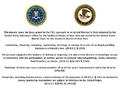
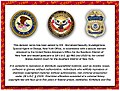
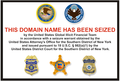


In the early 21st century, the US Department of Justice (DOJ) pursued the seizure of domain names, based on the legal theory that domain names constitute property used to engage in criminal activity, and thus are subject to forfeiture. For example, in the seizure of the domain name of a gambling website, the DOJ referenced and .[31][1] In 2013 the US government seized Liberty Reserve, citing .[32]
The U.S. Congress passed the Combating Online Infringement and Counterfeits Act in 2010. Consumer Electronics Association vice president Michael Petricone was worried that seizure was a blunt instrument that could harm legitimate businesses.[33][34] After a joint operation on February 15, 2011, the DOJ and the Department of Homeland Security claimed to have seized ten domains of websites involved in advertising and distributing child pornography, but also mistakenly seized the domain name of a large DNS provider, temporarily replacing 84,000 websites with seizure notices.[35]
In the United Kingdom, the Police Intellectual Property Crime Unit has been attempting to seize domain names from registrars without court orders.[36]
Suspensions
PIPCU and other UK law enforcement organisations make domain suspension requests to Nominet which they process on the basis of breach of terms and conditions. Around 16,000 domains are suspended annually, and about 80% of the requests originate from PIPCU.[37]
Property rights
Because of the economic value it represents, the European Court of Human Rights has ruled that the exclusive right to a domain name is protected as property under article 1 of Protocol 1 to the European Convention on Human Rights.[38]


0 Comments